Introduction
Fruit-based ingredients play a central role in modern food manufacturing. Beverage producers, dairy processors, ice-cream manufacturers and bakery companies frequently rely on fruit purées and fruit concentrates to deliver natural flavour, colour and nutritional value.
Although both ingredients originate from fresh fruit processing, their technical properties, logistics requirements and application performance differ significantly. Selecting the right ingredient can influence not only product quality but also production efficiency, storage stability and transport costs.
What is Fruit Purée?
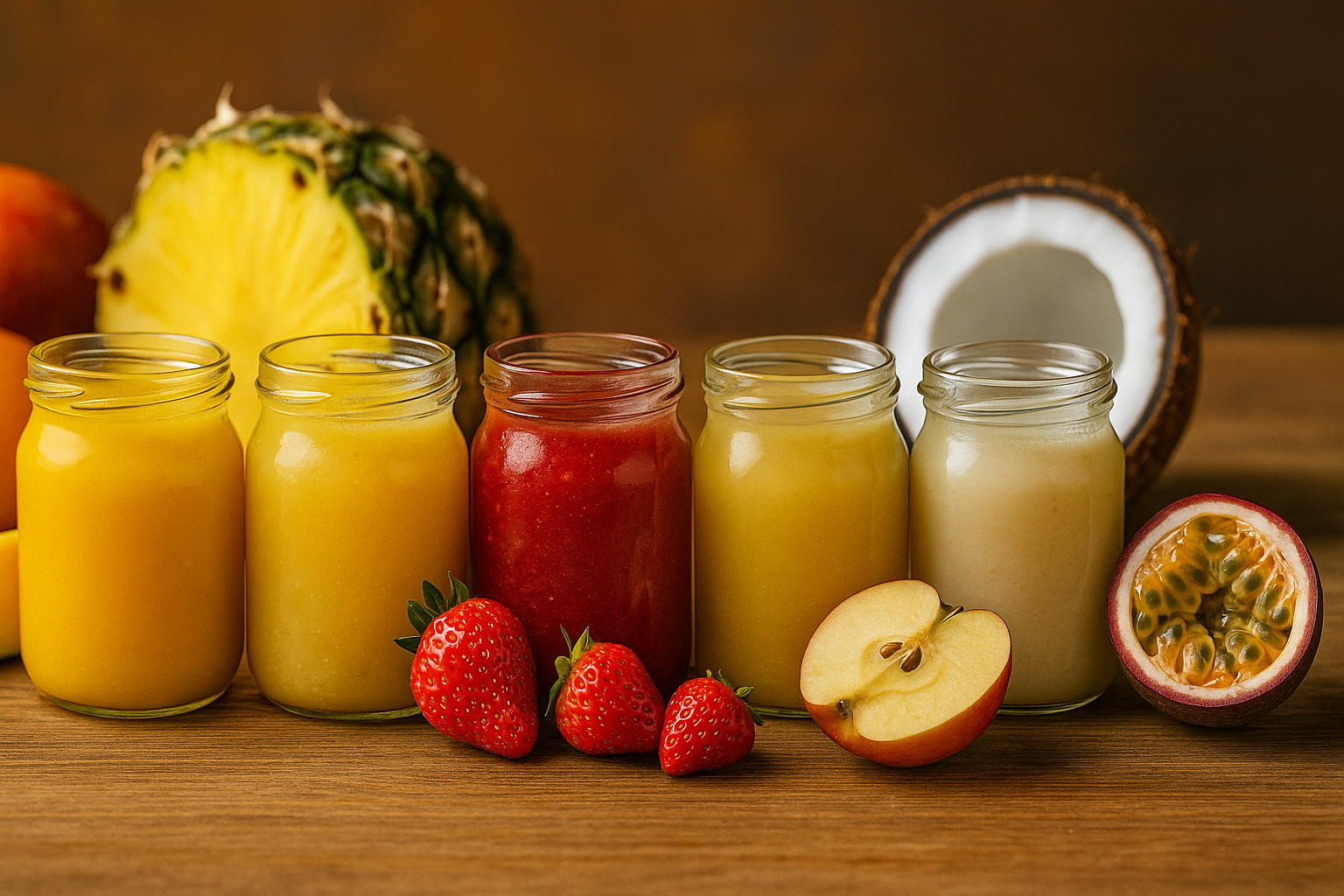
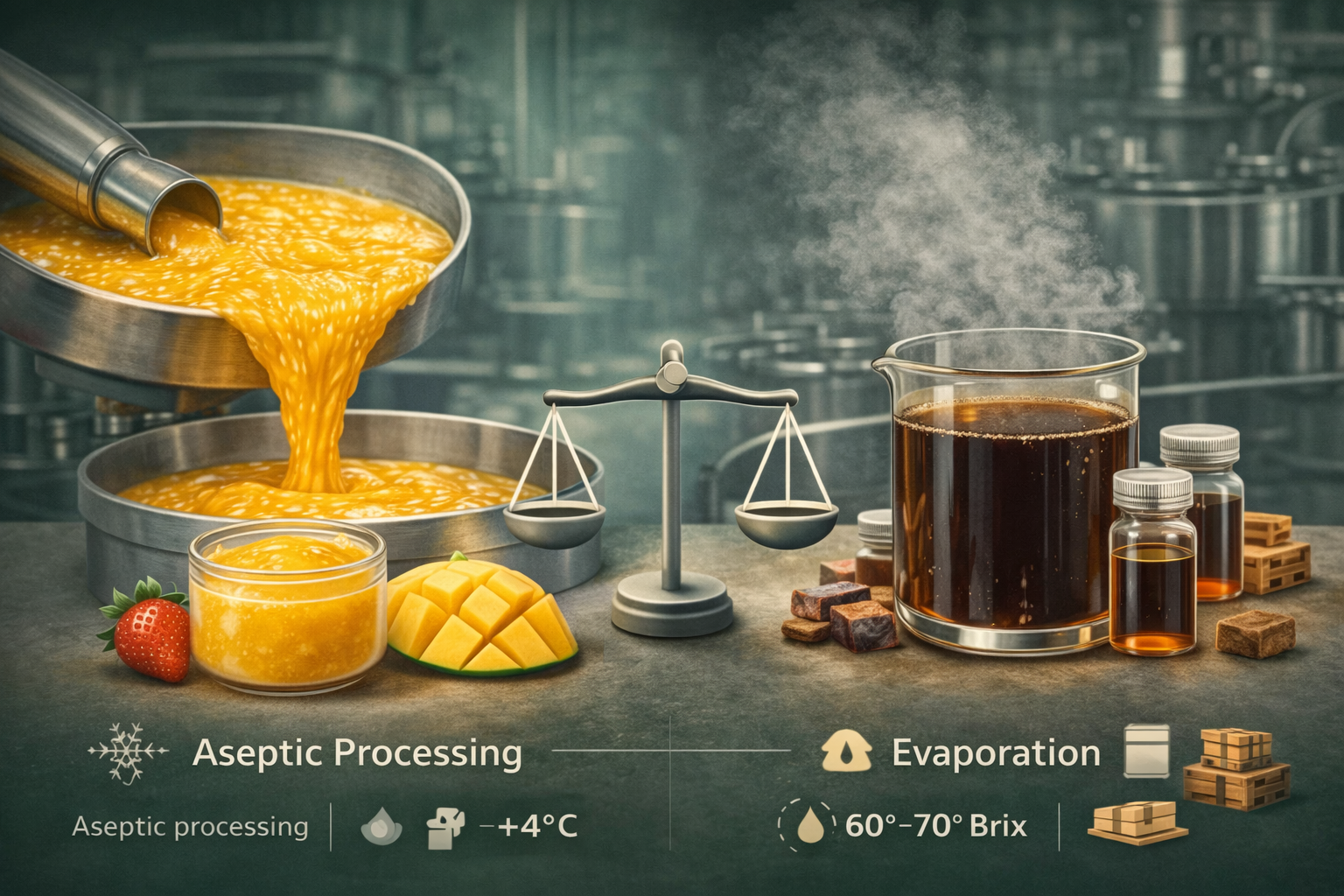
Fruit purée is produced by crushing or refining fresh fruit pulp, typically followed by pasteurization or aseptic processing.
Unlike concentrate, purée generally retains the original water content of the fruit, preserving a more natural texture and flavour profile.
Key characteristics
- Natural fruit texture
- Higher pulp content
- Fresh flavour profile
- Usually between 8°–20° Brix depending on the fruit
Typical applications
Fruit purées are commonly used in:
- Ice cream and gelato
- Yogurt and dairy products
- Smoothies
- Pastry fillings
- Fruit desserts
Because of their natural sensory profile, purées are particularly valued in premium and clean-label products.
What is Fruit Concentrate?
Fruit concentrate is obtained by removing a significant portion of water through evaporation, resulting in a product with much higher soluble solids.
Concentrates are widely used when logistics efficiency and shelf stability are priorities.
Key characteristics
- Higher Brix (typically 60°–70° Brix)
- Lower water activity
- Reduced transport volume
- Long shelf stability
Typical applications
Fruit concentrates are commonly used in:
- Fruit juices and beverages
- Carbonated drinks
- Confectionery
- Industrial syrups
- Flavoured dairy beverages
Logistics and Cost Considerations
From a supply chain perspective, concentrates offer clear advantages.
Because much of the water is removed during production, transporting concentrates significantly reduces freight costs per unit of fruit solids.
Purées, on the other hand, require temperature-controlled logistics or aseptic packaging, which may increase handling complexity but preserves the product’s natural character.
Choosing the Right Ingredient
The decision between purée and concentrate ultimately depends on:
- Product formulation
- Desired flavour intensity
- Production process
- Logistics constraints
- Cost structure
In many industrial formulations, manufacturers combine both purées and concentrates to achieve the ideal balance between flavour authenticity and operational efficiency.
Conclusion
Fruit purées and fruit concentrates are both essential ingredients in modern food production. Understanding their functional and logistical differences enables manufacturers to select the most suitable ingredient for each application.
With global sourcing networks and expertise in tropical fruit ingredients, Scala Nuova supports food manufacturers in selecting the right fruit ingredients for industrial production.
Frequently Asked Questions
What is puree concentrate?
It is fruit puree that has had part of its water removed while retaining pulp and fiber. It sits between single-strength puree and juice concentrate: it delivers body and texture, but with less water volume.
What is the difference between puree concentrate and juice concentrate?
Juice concentrate is liquid, clarified or cloudy, and has lost the pulp. Puree concentrate retains pulp and fiber, so it keeps the characteristic texture of a puree.
How do I compare the price of puree and concentrate?
Convert both to cost per solid by dividing the price per kilo by the Brix value, then add freight. A concentrate that looks more expensive per kilo is often cheaper because you are not paying to transport water.
Which format suits a beverage with a declared fruit content?
It depends on whether you need texture. For a clarified drink, juice concentrate is enough; if the label declares pulp or the product needs body, puree or puree concentrate is the right choice.
Are these supplied aseptic or frozen?
Both formats are available. Aseptic ships at ambient temperature with an extended shelf life; frozen requires a cold chain at −18 °C. Every lot ships with a COA and full specification.