
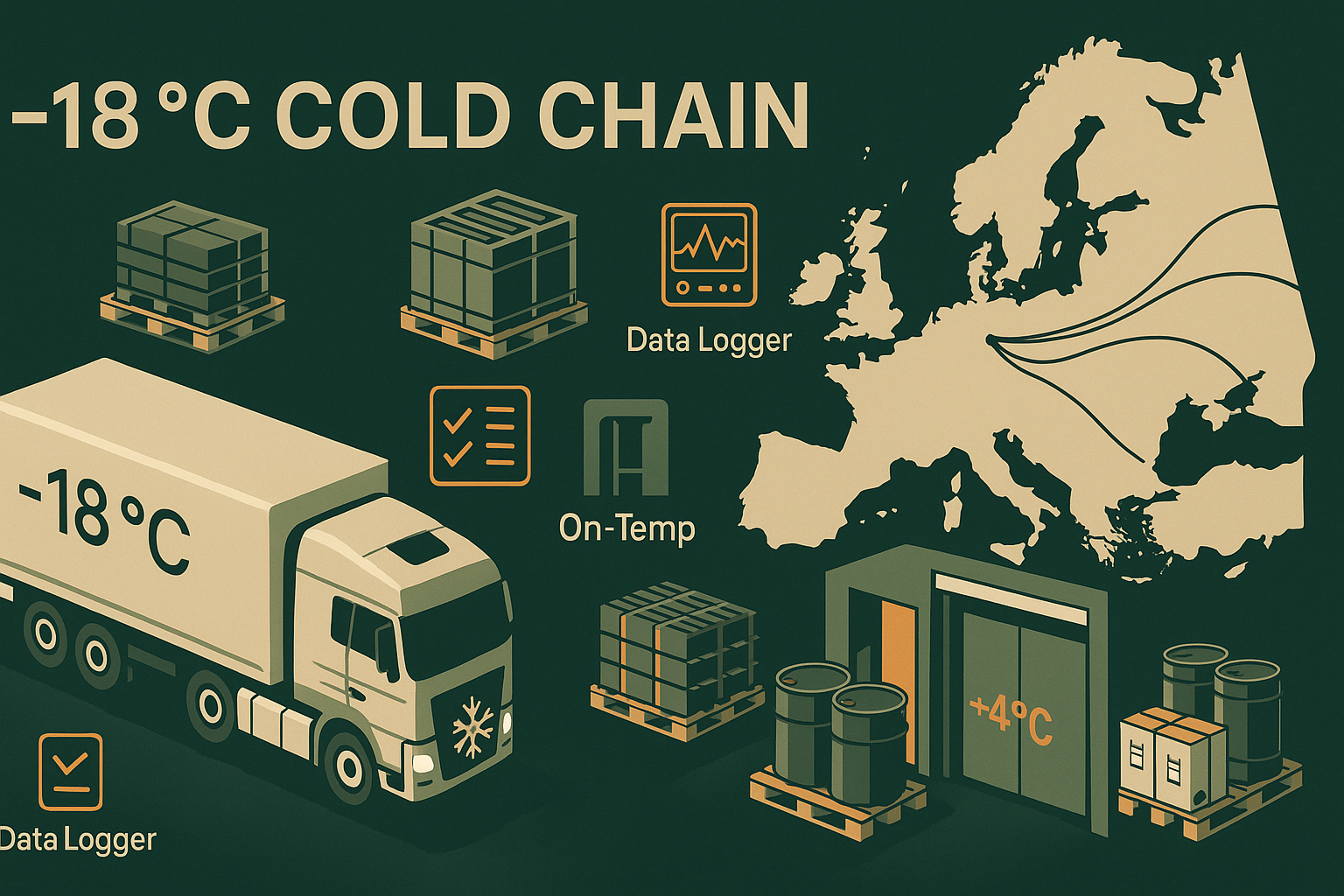
1) Temperature & Storage by Product
• IQF: –18 °C storage/transport; acceptance at core ≤ –12 °C (deviations → CAPA).
• Aseptic purées: Ambient/cool in sealed packs; keep away from heat/sun. After
opening, hold at +4 °C.
2) Operations (Trailer & Warehouse)
• Set-point & pre-chill: Trailer at –20 °C; pre-cool before loading.• Door openings: Scheduled slots, single-pass loading, thermal curtains.
• Airflow: Keep return-air channels open; no wall-hugging pallets.
• Data loggers: Read at dispatch/arrival; configure alert thresholds & notifications.
3) Pallet Design & Packaging
• Patterns: Brick/column to suit product; corner boards and interlayers.
• Wrapping: Tension matched to product; over-wrapping IQF crushes cases & blocks
cold airflow.
• Center of gravity: Vertical stability; top “cap” layer to prevent toppling.
• Aseptic drums/BIB: Anti-vibration dunnage; base protection against fork-marks.
4) Loading & Load Securement
• Zoning: Most temperature-sensitive SKUs away from doors; maintain airflow lanes.
• Anti-slip sheets & cross-strapping to prevent sliding.
• Stop minimization: Fewer door events → lower thermal drift.
5) Receiving & Checks
• Temperature: IR surface + core probing (IQF ≤ –12 °C); aseptic pack integrity.
• Visual: Abnormal frost patterns, leaks, deformation.
• Papers: CMR/BOL, lot list, logger report, non-conformance record.
6) CAPA — Deviation Handling
• Quarantine affected lots; analyze logger curve; pinpoint failure step
(warehouse/transport/receiving).
• Photo documentation; sample up to 10 % of impacted cases.
7) KPIs (Monthly)
• % On-temp deliveries, avg. door-open time, alarm rate, damage/1,000
cases, returns.
• Tie KPIs to carrier/supplier SLAs; quarterly reviews.
8) Cost Optimization
• Pallet fill rate: Reduce voids via interlayers & height standards.
• Routing: Prefer single-drop deliveries to cut door events.
• Packaging standardization: Harmonize BIB/drum/carton footprints to boost pallet
yield.
CTA: Need ready-to-use SOPs & checklists for your EU routes?
Contact info@scalanuova.fr
Internal links: /en/products/iqf, /en/products/purees, /en/quality
Frequently Asked Questions
What storage temperature applies to IQF versus aseptic products?
IQF requires −18°C storage and transport, with core temperature ≤−12°C on acceptance. Aseptic purees travel at ambient or cool temperature in sealed packs, and are held at +4°C once opened.
What trailer set-point should be used for IQF transport?
−20°C, with the trailer pre-cooled before loading.
Why does over-wrapping IQF pallets cause problems?
It crushes cases and blocks cold airflow, which is why wrap tension should be matched to the product rather than maximised.
What should be checked on receiving?
Surface and core temperature (IQF ≤−12°C), aseptic pack integrity, visual checks for abnormal frost, leaks or deformation, and the paperwork: CMR/BOL, lot list and logger report.
What happens when a temperature deviation is found?
The affected lots are quarantined, the logger curve is analysed to pinpoint the failure step, and up to 10% of impacted cases are sampled with photo documentation.
What KPIs are tracked monthly for cold chain performance?
Percentage of on-temperature deliveries, average door-open time, alarm rate, damage per 1,000 cases, and returns — tied to carrier and supplier SLAs.