1) Manufacturing Process
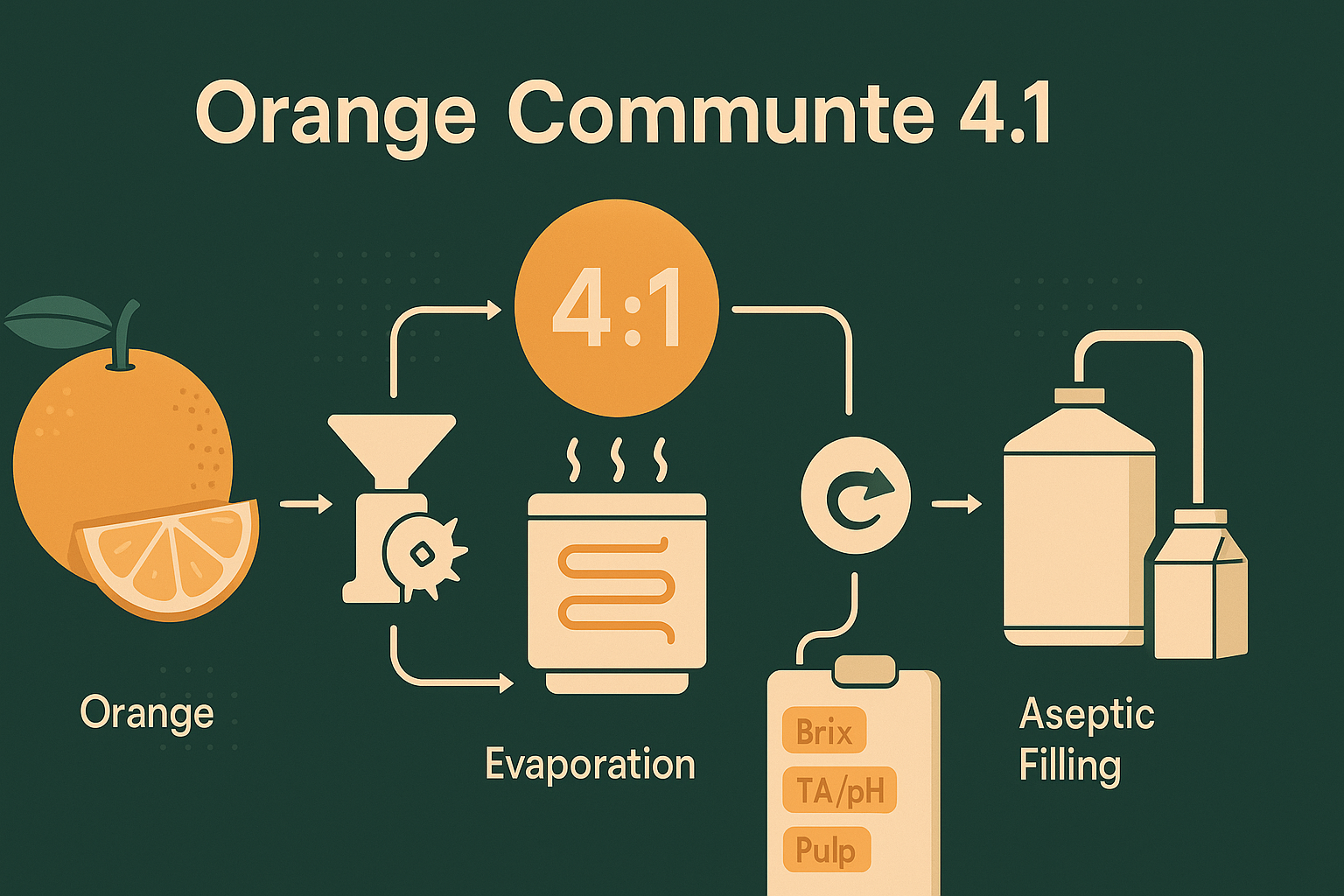
• Raw material: Ripe oranges (whole fruit).
• Comminution: Includes peel; preserves citrus character.
• Evaporation (4:1): Vacuum concentration, higher solids.
• Homogenization: Uniform pulp distribution and mouthfeel.
• Aseptic filling: Drums/IBC/BIB; ambient/cool storage for sealed packs.
2) Product Profile & QA
• Brix / TA / pH: Ranges aligned to target recipes.
• Pulp level: Fine/medium/high; particle size matched to filling line.
• Micro & physico-chem (CoA): Total count, yeast/mold, viscosity, insoluble pulp, oil.
• Sensory: Fresh orange note, balanced acidity, homogeneous pulp sensation.
3) Applications & Formulation Notes
• Soft drinks & RTD: Reconstitution to target Brix; consider cloud stability and aroma
recovery.
• Sorbets/Glazes: Viscosity and pulp govern crystallization and gloss.
• Operations: Filter/screen choice, mixing profile, optional thermal profile validation.
4) Packaging & Logistics
• Formats: Aseptic drums (~200 L), IBC, 10–20 L BIB.
• Palletisation: Corner boards, correct film tension, vertical stability.
• Traceability: Lot-level field-to-tank mapping; inbound/outbound CoAs.
5) Storage & Shelf Life
• Closed aseptic: Ambient/cool, away from sunlight.
• After opening: Hold at +4 °C and use promptly; minimize oxygen exposure.
6) Sourcing & Customization (Scala Nuova)
• Batch selection: Align Brix/TA/pulp to your specs.
• Rapid pilots: Line compatibility (pump/filter) and sensory validation.
• Seasonal continuity: Lot pooling to maintain steady profiles.
CTA: Request specifications, samples & pricing: info@scalanuova.fr
Internal links: /en/products/concentrates, /en/products/purees, /en/quality
Frequently Asked Questions
What is orange comminute 4:1?
Whole ripe oranges, including the peel, are comminuted to preserve citrus character, then vacuum concentrated at a 4:1 ratio and homogenized for uniform pulp distribution and mouthfeel.
What packaging formats are available?
Aseptic drums of approximately 200 L, IBC totes, and 10–20 L bag-in-box.
How is quality documented?
Each lot carries a Certificate of Analysis covering total count, yeast/mould, viscosity, insoluble pulp and oil content, alongside sensory evaluation for fresh orange note and balanced acidity.
How should it be stored before and after opening?
Closed aseptic packaging is stored ambient or cool, away from sunlight. Once opened, hold at +4°C and use promptly to minimize oxygen exposure.
What applications is it used in?
Reconstitution to target Brix for soft drinks and RTD beverages, and sorbets or glazes, where viscosity and pulp level govern crystallization and gloss.
How is seasonal continuity of supply maintained?
Through lot pooling across batches to keep Brix, titratable acidity and pulp level within a steady profile, with lot-level field-to-tank traceability.